

The forgotten nutrient: belonging -Because connection is as essential as food
Belonging is the forgotten nutrient shaping your child’s health, digestion, mental well-being, and resilience—just as powerfully as food. In this reflective, research-informed post, I explore why connection, shared routines, and family traditions are essential forms of nourishment. As winter break slows the pace of life, I invite all parents to reframe holiday overwhelm as an opportunity to cultivate belonging through simple, meaningful rituals like shared meals, cooking together, or evening walks. Drawing on cultural research and neuroscience, this blog post explains how belonging regulates stress, supports immune and digestive health, and protects against anxiety, burnout, and disordered eating. This winter, discover how small, intentional moments of togetherness can nourish your family far beyond the holidays—and create a legacy of connection that lasts.

No matter where all you parents live in the world, by now, your children would have had the last day of school before the holidays break. All the plans for Christmas, Hanukkah, friends and family get-togethers, shopping, meals, travelling, gifts are seemingly on a never-ending, anxiety festering list.
Breath.
Breath deeply and sign out the overwhelm of your mind (seriously, the research[1] found a decade ago that sighs are psychological and physiological resetters).
I’m here to ask you to look at this list as a “happy list”, after some deep breaths. I’m here to tell you that winter breaks offer a rare and meaningful pause—a moment when the usual rush of schedules, homework, and extracurricular demands finally softens. When children are home and days feel less structured, there is more room for shared moments that don’t need to be squeezed between obligations. This season invites togetherness not as another task, but as a natural rhythm.
The perfect opening to begin your family tradition
This slowdown creates the perfect opening to begin (or renew) a family tradition rooted in belonging.
Starting a family tradition doesn’t require planning something elaborate or picture-perfect. In fact, the most powerful traditions are often the simplest: a daily shared breakfast when everyone can sleep in, an evening walk after dinner, a holiday movie night, cooking one special meal together or baking holiday desserts. What matters most is consistency and intention. Repeated moments tell children, this time together matters, and over time, those moments become anchors of safety and identity.
Belonging: an essential nutrient
I recently came across this research[2] conducted a year ago, in December 2024, on some Caribbean populations. They were known to face complex health issues related to diet and food security as they undergo a rapid nutrition transition, resulting in some of the world's highest number of premature deaths from noncommunicable diseases. After exploring the generational, life course, and sociocultural factors influencing food sharing practices in the Caribbean, and interviewing participant from 6 different islands from 18 to 83 years of age, the conclusion was this: food sharing practices had a central role within the social fabric of all participants, contributing to their mental health and well-being. “They represented a fundamental aspect of participants' culture and traditions, driving a sense of belonging and connection among Caribbean communities. However, contemporary food sharing practices indicated a move towards more convenience-oriented and processed foods, with reduced time spent cooking and a decline in the use of food sources such as backyard gardens, fishing etc.”
When we talk about nutrition, we often focus on what’s on the plate: vitamins, minerals, macronutrients, superfoods. We debate organic versus conventional, homemade versus packaged, ancestral diets versus modern convenience. Yes, all of this has its own importance, but there is a nutrient almost never listed on a label—one that quietly shapes digestion, mental health, immune resilience, and even lifelong disease risk.
That nutrient is belonging.
The time to raise gathered and grounded children is now. The legacy of belonging is one they will carry on throughout their lives and one that will nourish your family (and in turn, their own family) bond for the years to come. Rooting them in a tradition that yields belonging is going to give them a confidence to face anything thrown their way, confidence often lacking in young adults who did not have an effective family support throughout their lives.
Belonging is the felt sense of being seen, safe, and valued within a group—most often, within your family. It is the reassurance that you matter, that your presence has a place, and that your story is connected to something larger than yourself. While it may sound abstract, research increasingly shows that belonging has tangible, biological effects on the body.
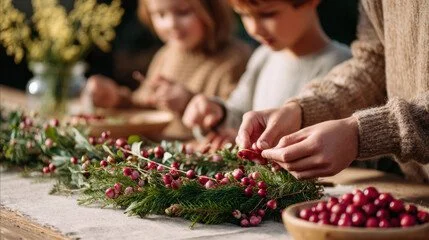
Family wreath making
Family traditions: a foundation of safety
Humans are wired for connection. Our nervous systems develop in relationship, not isolation. From infancy, regulation of stress, appetite, sleep, and emotional balance is shaped through responsive caregiving and predictable social rhythms. When children experience consistent family rituals—shared meals, celebrations, traditions, and daily moments of togetherness—their bodies learn safety. And safety is the foundation of health.
Chronic stress is one of the most damaging forces to human physiology. It disrupts digestion, blood sugar balance, hormone signaling, and immune function. A strong sense of belonging acts as a buffer against this stress. In children, belonging is associated with healthier eating patterns, improved academic outcomes, and reduced risk of anxiety and depression.
Family traditions play a powerful role in cultivating this sense of belonging. Traditions do not need to be elaborate or time-consuming. A weekly family meal, a shared bedtime routine, seasonal celebrations, cooking together, or even a consistent way of greeting one another at the end of the day—all of these create predictability and meaning. They tell a child, “This is who we are. You belong here.”
Nowadays, family traditions are often dismissed as optional or outdated. Productivity, independence, and efficiency are prioritized, while togetherness is treated as a luxury. Meals are eaten on the go. Schedules fragment families. Screens replace shared conversation. Yet we are left wondering why rates of burnout, anxiety, disordered eating, and chronic illness continue to rise—even in homes filled with “healthy” food.
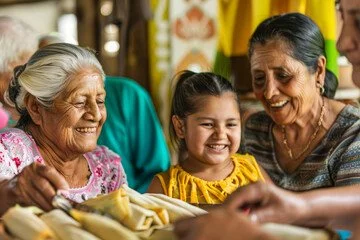
Multigeneration food preparing
Food is not enough to raise a healthy family
Nutrition does not operate in a vacuum. A child eating the most nutrient-dense diet in the world still eats within their own nervous system. If that nervous system is overwhelmed, rushed, or disconnected, the body cannot fully absorb the nourishment. Digestion, absorption, and metabolism are all influenced by our emotional state. Belonging helps shift the body out of survival mode and into a state where healing and growth can occur.
For parents, this can feel both comforting and challenging. Comforting, because belonging is not something that requires perfection, money, or expert knowledge. Challenging, because it asks us to slow down, to be present, and to prioritize connection even when life feels busy. The good news is that belonging is built in small, repeatable moments—not grand gestures.
A family table where everyone is welcome
A tradition of listening without interruption
A rhythm of showing up for one another, even imperfectly.
These are not just sentimental ideals; they are protective health practices.
As a holistic nutritionist, I believe food is powerful—but food is not enough. To raise healthy families, we must widen our definition of nourishment to include emotional safety, shared identity, and relational connection. Belonging is the soil in which all other nutrients take root. Without it, even the most carefully chosen foods cannot do their full work.

Family movie night
So...
Belonging is not optional. It is not extra.
It is the forgotten nutrient—and it may be the most important one of all.
I am here to tell you that your time to start this is now, this winter break.
Winter, with its shorter days and inward pull, is especially supportive of connection. Shared routines during transitional periods—such as this holiday break from school—help children regulate stress and strengthen emotional security. A new tradition introduced now can gently carry forward into the rest of the year, becoming a familiar touchpoint even when life speeds up again. The body remembers these rhythms, just as it remembers nourishment.
By choosing to start a tradition this winter break, families are not “adding one more thing” to their lives—they are investing in the forgotten nutrient of belonging. These small, intentional rituals send a powerful message: You belong here. We make time for one another. And long after the break ends, that sense of belonging continues to nourish the whole family.
With all my love throughout the holiday season,
Oana, Your Family Wellness Nutritionist 💖
Resources:
[1] Vlemincx E, Van Diest I, Van den Bergh O. A sigh of relief or a sigh to relieve: The psychological and physiological relief effect of deep breaths. Physiol Behav. 2016 Oct 15;165:127-35. doi: 10.1016/j.physbeh.2016.07.004. Epub 2016 Jul 9. PMID: 27404329.
[2] Brugulat-Panés A, Foley L, Murphy MM, Unwin N, Guell C. An exploratory case study of food sharing practices in Caribbean countries through a transition lens using intergenerational dyad interviews. Global Health. 2024 Dec 24;20(1):88. doi: 10.1186/s12992-024-01094-0. PMID: 39719616; PMCID: PMC11669230
GET sTARTED
Ready to see how we can move you and your family from surviving to thriving?
Your first call is complimentary.
